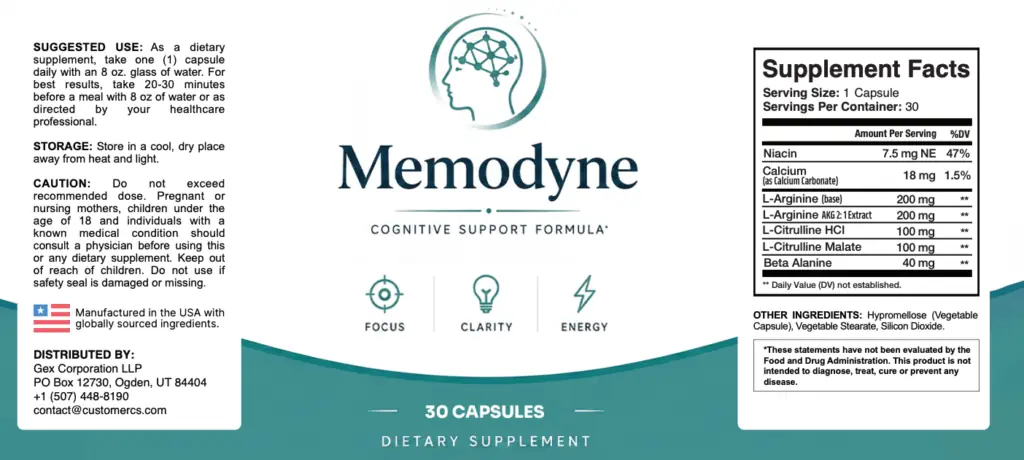
Flip over a bottle of Memodine and the Supplement Facts panel lists seven ingredients, each with its own milligram amount: L-Arginine (Base) 200mg, L-Arginine AKG 2:1 Extract 200mg, L-Citrulline HCl 100mg, L-Citrulline Malate 100mg, Beta-Alanine 40mg, Niacin 7.5mg NE, and Calcium 18mg. Add those seven numbers together and you get exactly 665.5mg — the total active yield per capsule.
That number matters less on its own and more because of what it represents: every gram of what you're swallowing is accounted for on the label. There's no catch-all "proprietary blend" line hiding an unknown ratio of ingredients behind a single combined weight. You can see precisely how much of each ingredient you're getting, which makes it possible to actually research each one individually — something a blend label doesn't allow.
Why Manufacturers Use Blends At All
Proprietary blends exist mostly to protect a formula from being copied by competitors, and sometimes to make a cheap, low-dose ingredient look more impressive sitting next to bigger names on a label. Neither reason benefits the person taking the capsule. When you can see 665.5mg broken into seven named amounts, you can compare each dose to published research on that specific ingredient, rather than trusting a total number that could be mostly filler.
Is 665.5mg A Lot?
Milligram totals aren't meaningful without context — a supplement can list a large total number while individual actives sit at doses too small to do much. What matters is whether the doses of ingredients like L-Arginine and L-Citrulline are in a range commonly used in circulation-focused formulas. In Memodine's case, the two L-Arginine forms (200mg + 200mg) and two L-Citrulline forms (100mg + 100mg) sit within that commonly used range, which is a more useful way to evaluate the formula than the total alone.
The Bottom Line
665.5mg isn't a marketing number — it's simply what seven named, dosed ingredients add up to. See the full breakdown on the Memodine ingredients page.
See Memodine Pricing